

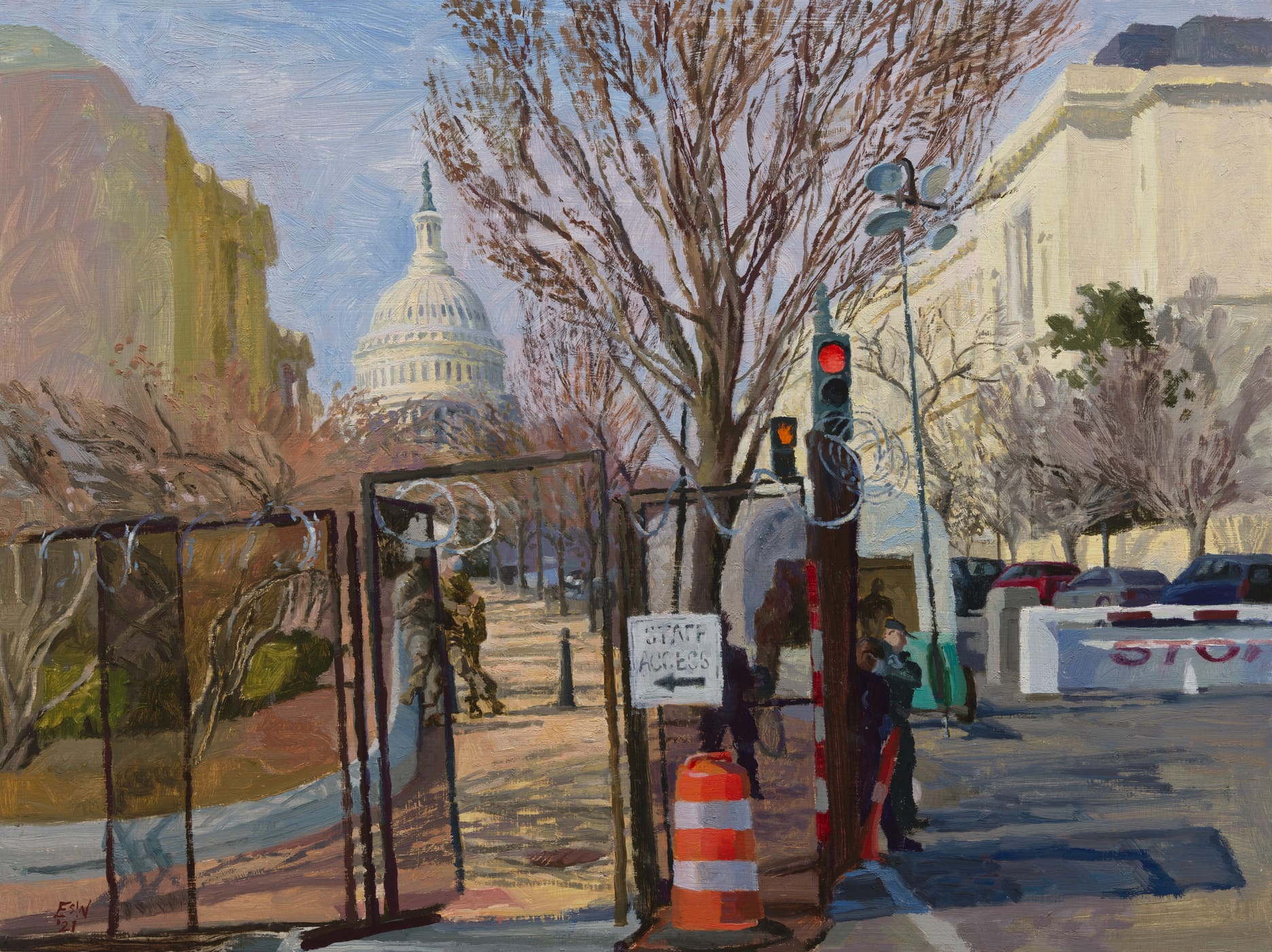
Elaine S. Wilson’s direct, light-filled landscapes reveal the specific nature of a place through repeated encounters with a site. She values slow looking to discover what is going on there and to find its unexpected lyricism. She often chooses sites related to issues of displacement, disruption and inequity.
Wilson holds her MFA in painting from Yale School of Art and her BFA from Washington University in St. Louis School of Art. Her work is in the collections of the Grand Rapids Art Museum, Library of Congress, The University of Michigan Office of the President, Washington DC Artist Bank, Herman Miller, and Cigna Corp. as well as numerous private collections.
She has exhibited widely with over twenty-five solo shows, and has been included in numerous group exhibitions.
She has received a National Endowment for the Arts Regional Artists Fellowship, a DC Commission on Arts and Humanities Grant, and Elizabeth Greenshields Foundation Grant, and a residency at the Josef and Anni Albers Foundation.
Wilson’s over thirty years of teaching include College for Creative Studies in Detroit, University of Michigan School of Art and Design, and Washtenaw Community College in Ann Arbor.
She lives and works in Silver Spring, Maryland.

Elaine Wilson’s Beautiful Worlds
There is something going on in Elaine Wilson’s work. In images like Renovating the Capitol (outside) and Renovating the Capitol (inside), where the imagery depicts the contentious relationship between spatial and temporal elements, there is something else. Perhaps it has to do with the scaffolding on the Capitol dome and the shadows of passersby in Renovating the Capitol (outside). Maybe it has something to do with the altered growth of the trees and the association by color of those trees with blocks of stone in Renovating the Capitol (inside)—elements of her work which speak to the outward appearance of conflict between our physical and natural worlds, but which somehow don’t end there.
In these and other of Wilson’s works, Wilson seems to want to interrogate the human and natural worlds, how they are alike, how they differ, and what happens when they interact. Initially, she demarcates boundaries and examines the interfaces. Human beings, she tells us, build things, like the Capitol building, symbolic of our ability to formulate and express power. Seen in summer light, the Capitol dome, despite its need for renovation, seems an enduring monument to our ability to assert, situate, and project order. We can harvest and cut stone, fashion it as we would timber, and shape it to our needs. But there is more. The passersby outside the Capitol cast their own shadows. Because they are small, they suggest that the shadows human beings cast are not so large as we might think, and, additionally, they remind us of other shadows, like those in the windowsills of our buildings, in the joints of our sidewalks, and in the seams where we have joined stones. Meanwhile, overhead, nature builds another kind of capital. Out of a clear sky, clouds darken with moisture and the capacity for lightening.
It would seem, then, that what Wilson is trying to show us is the world within the world. The first world is the world we inhabit. It is both static and variable, the variability, though, mostly coming in patterns, like spring rains, with a predictability that normalizes them. The second world is the world we normally don’t see, and thus normally don’t acknowledge. It exists in both the human and natural domains and is where change really occurs. When this world intrudes upon the former world, it seems to have done so without warning and usually with great violence, like the sudden slippage between tectonic plates. We call these kinds of intrusions calamities, disasters, tragedies.
What Wilson wants to remind us, I think, is that these sudden intrusions are neither sudden nor intrusive. Rather, they are the result of ongoing processes, processes which were initiated long ago and which are continuing right now, at this moment, while you are reading. This kind of change is not accomplished all at once, but gradually, incrementally, by the slow operation of untold numbers of usually unobserved mechanisms. Take, for examples, the micro-cracking of stone which, without intervention, will break that stone or the burial of that stone by successive generations of fallen leaves so that, in its internment, it will be disassembled entirely by natural processes.
This type of change, whether human or natural, whether explored in the figure of a spreading vine, as it is in Ten Towers with Vines, or as it is can be seen at a distance, as it is in Center of the World, suggests that change is ubiquitous, patient, predictable, even beautiful. It is this beauty that Wilson sees in change which animates her landscapes and is what you might find remarkable in her work.
–John Haslem Jr.